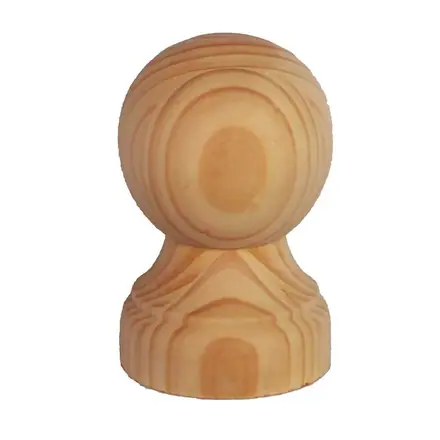
Timber Post Caps and Knobs: Measure the Post, Not Just the Product Code
A post cap has to suit the post beneath it as well as the style of the fence or balustrade. A product code, a cap diameter and a post width describe different things. Keeping them separate is particularly important when replacing a few caps in an existing run.
Start with the Heritage post knobs and capitals: C1 Ball, C2 Acorn, C3 Windsor, pyramid post tops and the separate pyramid/Danish-style capitals. Compare the actual dimensions and mounting shape before counting quantities.
Choose the profile from a clear reference
The Ball profile is round, the Acorn has a more shaped turned outline, and Windsor provides another distinct turned pattern. A pyramid top creates a different silhouette again. Photograph an existing cap from the front and side if the new piece must match it.
Give the workshop one nominated reference. If earlier replacements have left two designs on the fence, mark which is intended to remain. “Match the existing caps” is ambiguous when the photographs show more than one pattern.
Measure across the post’s flats
Measure the post near its top in both directions. Do not use the widest part of a decorative base, a surrounding moulding or the diagonal distance across a square post. Note chamfers, weathering and any unevenness that affects the top surface.
If access is unsafe, obtain the measurement through the installer. Avoid removing a sound cap simply to inspect the fixing; photographs and accessible dimensions can begin the enquiry while the installation detail is assessed separately.
The number in a code is not always the finished diameter
Heritage lists the smaller turned knobs in 86mm and 108mm finished diameters under codes that include 95 and 120. That is why an order should record the product code and the confirmed finished dimension rather than converting the code directly into a diameter.
For larger C1, C2 or C3 capitals, ask the workshop to confirm the finished dimensions. A family resemblance in the photograph does not establish that two sizes share the same base or overall height.
Check which kind of pyramid top you mean
C4120 and C4140 are the listed pyramid post tops for 120mm and 140mm posts. PYR95, PYR120 and PYR140 refer to the separate pyramid/Danish-style capital range, specified against post-size ranges.
Use the exact code rather than “pyramid cap”. Also confirm whether the selected item sits on the post or has a fitting detail that must accommodate it. A top that looks suitable from above can still be wrong underneath.
Count the different posts along the run
Gate posts may differ from the smaller posts between fence panels. Newels at a stair or landing may also differ from the posts elsewhere. Sketch the run and group the caps by post section and selected code.
An illustrative schedule might list two larger gate-post tops and six smaller fence-post knobs. Keep those as separate lines even when you choose the same visual family. Include any spares you want explicitly rather than leaving the workshop to infer an allowance.
Coordinate the adjoining timber
Compare the cap with the newel below it, neighbouring rails and gate design. A gable finial is a separate roofline feature; its name should not be used as a substitute for a fence-post cap on the order.
Ask the installer to confirm the mounting arrangement and follow the preparation instructions for the specified material, including inaccessible faces before fixing. Send your marked photographs, post sections, selected codes, quantities and delivery postcode with a post-cap enquiry. Confirm the finished dimensions in the written specification before manufacture.