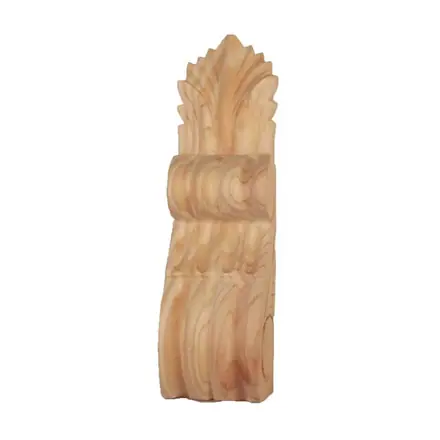
Choosing Turned or Carved Timber Corbels for Shelves and Mantels
Choosing a timber corbel starts with two separate questions: what should the visible detail look like, and what support does the installation require? A catalogue photograph helps with the first. It does not answer the second.
Heritage’s turned and carved corbels provide different profiles for decorative joinery. Establish the available space and the intended use before choosing a pattern purely because it resembles a mantel or shelf you have seen elsewhere.
Turned detail and carved detail read differently
A turned profile is built around the curves and transitions of the turning: beads, coves, shoulders and straighter sections. A carved corbel presents relief and scrollwork across its visible face. Compare the side view as well as the front, because the projection can change the appearance considerably.
Use the COR code to keep the choice specific. COR2 and COR3, for instance, are different patterns even where their listed overall dimensions are similar. A request for “the medium carved corbel” leaves room for the wrong interpretation.
Measure three dimensions and label them
Record the vertical space available, the width of the visible face and the distance the corbel can project from the wall. Keep these labels on the drawing rather than sending three unlabelled figures. The order of dimensions in a catalogue can differ between turned and carved items.
The published COR2S dimensions provide a useful reading example: 222mm tall, a 70mm face and 50mm depth. Those are three distinct dimensions, not alternative descriptions of one size. Check the selected product’s current listing before ordering.
Try a simple outline before committing
A paper or cardboard outline can help you judge proportion without fixing anything to the wall. Mark the proposed corbel height, face width and projection, then view it alongside the shelf, cabinet or surrounding trim. Use a side-view sketch where a flat outline cannot show the projection.
This is a visual planning exercise. It does not test strength, fixing suitability or the condition of the wall. If two corbels frame a mantel or cabinet, check both positions rather than assuming the available space is symmetrical.
Do not infer a load rating from the shape
Heritage does not publish a load rating for these decorative corbels. Tell your installer what the assembly will carry and have them determine the support and fixing arrangement. The size of a scroll is not a substitute for a structural specification.
For a mantel or other detail near an appliance, have the appliance manufacturer’s requirements and the appropriate installer determine the permitted position. This guide is about selecting joinery, not setting fireplace clearances or approving a heat-exposed installation.
Confirm the material for the location
The listed corbels are clear pine, which is untreated. They should not be assumed suitable for an exposed outdoor position. The external LOSP H3 treated-pine guarantee does not automatically apply to clear-pine corbels.
If the intended position is outdoors, describe the exposure and ask the workshop to confirm a suitable product and material. A corner or eaves bracket is a separate range, not simply another name for an interior corbel.
When you are matching a surviving corbel
Photograph it square-on and from the side, with a ruler in the same plane as the timber. Record the full outline and the soundest details. Explain whether you need one replacement beside an original or a complete new set; that changes how closely the new work needs to follow an existing profile.
Send the sample or photographs for a matching assessment rather than assuming the nearest COR design is an exact copy. Include quantity, location, dimensions and delivery postcode in your corbel quote enquiry.