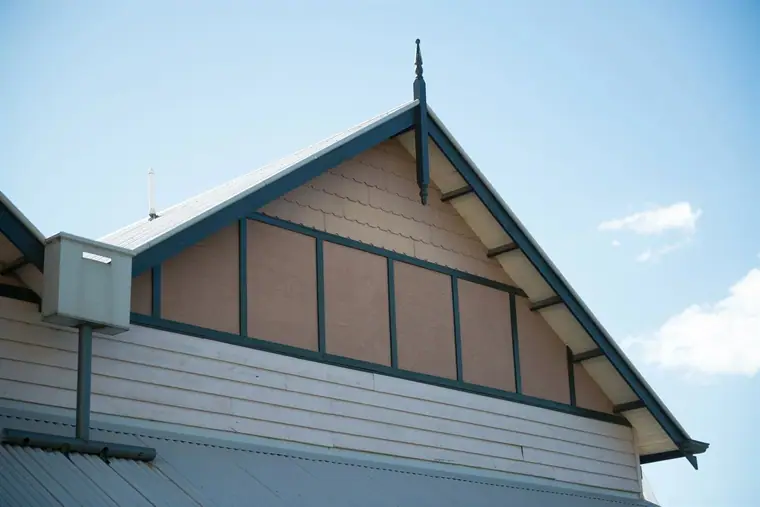
Choosing a Replacement Timber Gable Finial: Profile, Section and Length
A replacement gable finial needs three decisions: which profile to use, how substantial the square section should be, and how long the finished piece needs to be. Choosing only the silhouette can leave you with a finial that resembles the original close up but looks too small against the roof.
Start with the roofline and a surviving detail, then use the F1–F4 finial range to compare the options. Heritage supplies decorative timber from Bayswater, Victoria, with delivery Australia-wide.
Keep the three measurements separate
The design identifies the turning. The section describes the square timber across its flats. Overall length describes the complete piece, including sections that may overlap the surrounding roof detail. One number cannot stand in for all three.
For an existing finial, label a photograph with the overall length and section where those can be measured safely. Mark hidden portions as unmeasured. A photograph from the street is useful for proportion, but perspective makes it unsuitable for calculating exact dimensions.
Compare the roofline as well as the turning
Take one photograph showing the full gable and another showing the finial. Include the barge boards, the apex and nearby decorative details. A heavily patterned barge board and a plain roof edge create different settings for the same turning.
If a neighbouring gable retains an original finial, photograph it too. Explain whether you want to repeat that detail or reproduce a different surviving piece. Do not assume two finials on the same house were originally identical; older repairs can introduce a second pattern.
Use the calculator to check available combinations
The current Heritage calculator covers F1, F2, F3 and F4 in selected sections and lengths. Not every design and section is offered at every length. Choose the actual design, section and length in the calculator rather than estimating a price from a similar photograph.
For example, an enquiry reading “F3 design, 70mm square, 1200mm overall, quantity two” is clearer than “two large finials”. This is a specification example, not a recommendation that those dimensions suit your roof. Confirm the selection against the available choices and your installation requirements.
What if the original is not a catalogue profile?
Send close photographs or a sample for a timber-profile matching assessment. Include beads, rings, shoulders and plain sections in the record. A broken top may still leave useful evidence lower down, so retain the fragments rather than discarding them before the workshop has seen them.
A matching enquiry is an assessment, not automatic confirmation that every material and profile can be reproduced. The workshop will need to confirm the pattern, dimensions and material before manufacture.
Separate the product from the installation
A decorative finial photograph does not establish how it should be attached to your particular roof. Give the installer the proposed dimensions and ask them to confirm the fixing arrangement and access. Do not climb onto a roof or remove an existing piece simply to complete an enquiry.
Before installation, follow the preparation instructions for the specified timber. The LOSP H3 pine care guide applies to that material; it should not be treated as a universal coating specification for other timbers or plywood.
Your finial enquiry checklist
- Preferred F1–F4 design, or photographs of the original.
- Square section and overall length, with unknown dimensions identified.
- Full-gable photograph and close detail photographs.
- Quantity, installation position and delivery postcode.
- Any requirement to match an existing finish or adjacent barge board.
Send the finial brief for a written quote. Keep your selected profile and dimensions together so the workshop can check the same specification you are considering.